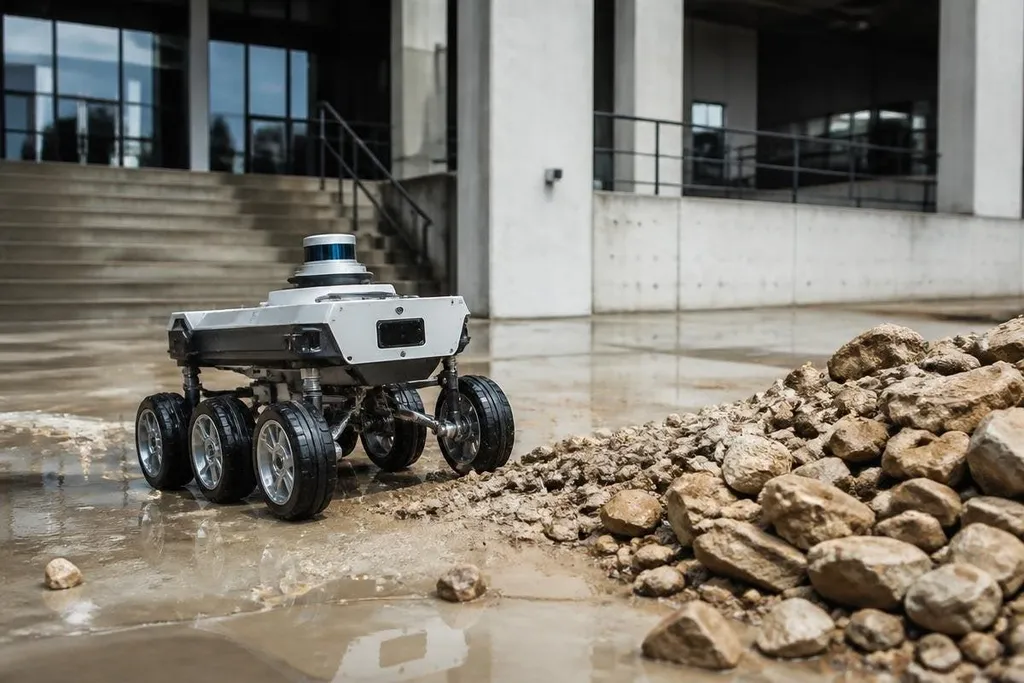
A mobility robot has to do three things before any smart software matters: stay upright, move over changing ground, and stop when its path becomes unsafe. The biggest gains have come from solving those physical tasks together, not from adding another layer of software.
- Wheels make motion efficient on prepared floors.
- Legs handle steps, gaps, and uneven ground.
- Sensors turn movement into a control problem the robot can measure.
Wheels made useful robots possible
Wheeled robots remain the practical starting point for many indoor jobs. A motor turns the wheel, encoders measure rotation, and a controller compares that movement with the route it was given.
That setup uses less energy than lifting a leg on every step. It also needs fewer moving parts, which can reduce service work. A flat warehouse floor suits wheels well because the robot can keep steady contact with the ground.
The limit appears at the edge of that floor. A door sill, loose cable, ramp, or broken surface can stop a small wheel. More drive power doesn't fix a wheel that cannot climb over the object in front of it.
Legs brought control to rough ground
Legged robots solve a different problem. Each foot can move to a new contact point, so the robot can step over gaps and place its weight where the ground offers support.
An inertial measurement unit, or IMU, measures acceleration and body rotation. The control system combines that data with joint sensors and foot contact data to adjust the robot's position while it walks.
That work is harder than driving a wheel. A legged robot must manage balance while its feet leave the ground, and every step spends energy. The result can be useful on stairs, rocky paths, and work areas built for people rather than machines.
The gap between a lab walk and a paid job is still wide. A robot may cross one obstacle in a video and fail when the same obstacle appears at a different angle, under a different load, or in poor light.
Sensors changed where robots can move
Movement became more useful when robots could measure the space around them. LiDAR sends out light pulses and measures their return time. Cameras record images. Wheel encoders and an IMU tell the system how its body has moved.
Software can combine those inputs into a map and estimate the robot's position inside it. That process is often called simultaneous localization and mapping, or SLAM. The name sounds grander than the job: the robot builds a map while trying to work out where it is on that map.
This matters to an operations manager because a route can change after installation. A pallet may block an aisle, or a person may cross the robot's path. Sensors let the system check the space again instead of following a fixed line on the floor.
Hybrid mobility systems may use wheels on flat floors and legs for steps or broken ground. Robot24.com’s mobility robotics reporting can tie those claims to the route, payload, test date, and operator role, so you can judge where each design has worked before the comparison moves to cost.
Hybrid designs are narrowing the trade-off
Some machines combine wheels and legs. Wheels handle long, flat sections with low energy use, while legs help the robot cross a step or rough patch.
The control system must decide when to roll, when to step, and how to keep the load stable during that change. That design adds motors, sensors, and software, and it can also add new service points.
A hybrid robot earns its place only when the site has enough changes in floor height or surface type to repay that extra hardware.
I’d choose wheels for a mapped indoor route and legs only when the site’s obstacles justify their cost and energy use.
Check the machine against the site
Before you compare mobility robots, use this short check:
- Map the floor: record slopes, door sills, loose cables, floor gaps, and areas where people work.
- Measure the load: include the payload, gripper, battery, and any frame that rides on the robot.
- Count the stops: note how often charging, loading, safety checks, or human help will interrupt the route.
- Test the weak surface: include dust, wet patches, metal plates, gravel, or any floor the robot will meet in service.
- Set a failure rule: decide how the robot should stop, call for help, and recover after a blocked route.
The next useful breakthrough won't be a robot that crosses one difficult course. It will be a mobility system that repeats the same work across changing floors, carries its rated load, and reports its failures clearly enough for a person to fix the cause.